3 min read
Artificial intelligence is not just transforming software. It is transforming physical infrastructure.
Across the country and around the world, new data centers are being designed and constructed at a pace the industry has never seen before. Every one of those facilities requires enormous amounts of fabricated metal to function.
Server racks. Structural frames. Cable management systems. Cooling infrastructure. Power distribution enclosures. Equipment housings.
None of it exists without fabrication.
For fabrication shops, the rise of AI is not a disruption. It is one of the largest opportunities the industry has seen in decades.
And the shops that are prepared to support this new infrastructure build-out will play a direct role in powering the future of technology.
The Data Center Construction Boom
Artificial intelligence requires massive computing capacity. Training and running AI models depends on dense clusters of high-performance servers, and those servers live inside data centers.
As AI adoption speeds up, companies are building more data centers than ever before.
Technology companies are investing billions of dollars in new facilities. Utilities are expanding electrical infrastructure to support them. Construction firms are racing to keep up with demand.
Every one of these projects is an enormous amount of metal fabrication.
Rows of server cabinets require precision sheet metal. Installers must fabricate and then install cable tray systems throughout entire buildings. Cooling systems require structural assemblies and mounting frames. Power distribution equipment relies on custom enclosures and brackets.
Fabrication shops that can deliver precision, repeatability, and speed are helping build the backbone of the AI economy.
Where Fabrication Fits Inside a Data Center
A modern data center is far more than a room full of computers. It is a complex industrial environment that depends heavily on fabricated components.
Server rack systems require accurate metal framing that can support thousands of pounds of equipment while maintaining airflow and cable access.
Cable management infrastructure relies on extensive tray systems, brackets, and supports that must be fabricated to exact specifications.
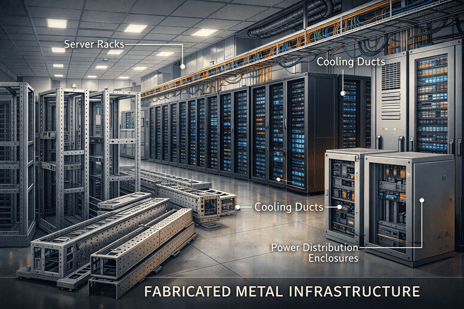
Cooling assemblies require mounting systems, structural supports, and custom housings that allow large-scale airflow and thermal management.
Power systems depend on enclosures, panels, and mounting structures that protect and organize critical electrical equipment.
These components are produced through fabrication processes such as laser cutting services, custom metal bending, and robotic welding.
As data centers continue to scale in size and density, the demand for precision fabrication grows alongside them.
Why Speed Matters in Data Center Projects
Data center construction moves quickly. Technology companies want new facilities online as fast as possible because computing capacity directly affects their ability to deliver services.
That means fabrication partners must be able to move from design to production efficiently.
Laser cutting services allow shops to produce complex components with speed and precision. High-performance fiber laser systems can process intricate parts while maintaining tight tolerances that data center assemblies require.
Custom metal bending ensures structural parts and brackets fit perfectly during installation. Accurate press brake work reduces delays and prevents costly rework during construction.
Robotic welding helps maintain consistent weld quality while increasing throughput. Automated welding systems allow shops to produce repeatable assemblies at scale, which is essential when projects require large volumes of identical parts.
Together, these capabilities support reliable, high-quality value-added metal fabrication that keeps infrastructure projects running.
The Importance of Design Collaboration
Many of the most successful fabrication partnerships begin before production even starts.
When fabrication teams are involved early in the design process, they can help optimize components for manufacturability. Small design adjustments can reduce material waste, simplify welding operations, or improve assembly efficiency.
This type of collaboration allows projects to move from concept to production more smoothly.
Design for manufacturability practices help ensure that fabricated parts perform exactly as intended while minimizing delays during construction.
For large infrastructure projects such as data centers, that level of coordination can make a significant difference in schedule reliability.
Fabricators that combine sound engineering knowledge with modern production technology become valuable partners in the construction process.
The Technology Behind Modern Fabrication
Today’s fabrication shops rely on advanced equipment and automation to meet the demands of large infrastructure projects.
Laser cutting services provide clean, precise cuts across a wide range of metals and thicknesses. These systems allow complex shapes to be produced quickly while maintaining consistent quality.
Press brake technology supports accurate custom metal bending for structural components, brackets, and enclosures used throughout data center facilities.
Robotic welding systems bring another level of consistency and efficiency. Automated weld cells ensure repeatable results across high-volume assemblies while allowing skilled welders to focus on more complex work.
When these capabilities work together, fabrication shops can deliver the type of precision and reliability that large infrastructure projects require.
Fabrication Is Powering the AI Economy
Artificial intelligence may live in software, but it runs on physical infrastructure.
Every AI model depends on servers. Every server depends on a data center. And every data center depends on metal fabrication.
Fabrication companies providing laser cutting services, custom metal bending, robotic welding, and other processes are directly contributing to the construction of the digital economy.
As data center construction continues to speed up, the role of fabrication will only become more important.
Shops that invest in precision, automation, and engineering collaboration will be well positioned to support this next generation of infrastructure.
Because behind every breakthrough in artificial intelligence is a building full of equipment.
And behind that building is a fabrication shop that helped make it possible.
If you have a project ready for review, upload your RFQ here: