Welded assemblies rarely run into trouble because of strength alone. More often, issues stem from overlooked weld access, poor sequencing, or unplanned distortion. Designing with the welding process in mind, especially when leveraging robotic welding services, leads to faster builds, better quality, and more consistent results. It’s a core part of delivering true value-added metal fabrication.
A Practical DFM Checklist for Welded Assemblies
1. Make weld access easy
Whether welding manually or through robotic welding services, access matters. Torches, MIG guns, and robotic arms need proper approach angles. Tight corners, deep pockets, or boxed-in joints slow production and increase the risk of inconsistent welds. Design joints that allow smooth, unobstructed movement.
2. Specify only the weld size required
Oversized welds don’t just add strength; they add heat, distortion, and cycletime. That’s especially important in high-volume or robotic applications where efficiency drives cost. Use calculated weld sizes instead of defaulting to“bigger is safer.”
3. Design for simple fixturing and repeatability
When parts have flat reference surfaces, balanced shapes, and consistent dimensions, they’re much easier to hold in place and set up, whether you’re using manual fixtures or automation. Robotic welding services rely on repeatability. Parts that self-locate reduce setup time, minimize variation, and support scalable production, a key component of value-added metal fabrication.
4. Plan for weld distortion early
Heat input causes movement. Long continuous welds, thick-to-thin transitions, and unbalanced weld patterns can pull assemblies out of alignment. Consider stitch welds, balanced sequencing, or temporary bracing to control distortion before it affects downstream operations.
5. Reduce weld count and repositioning
Every weld adds labor and cycle time. Every part flip adds risk. Where possible, combine components, replace welded features with formed ones, and orient joints so multiple welds can be completed in a single setup, ideal for both manual and robotic welding workflows.
6. Match the joint to the welding process
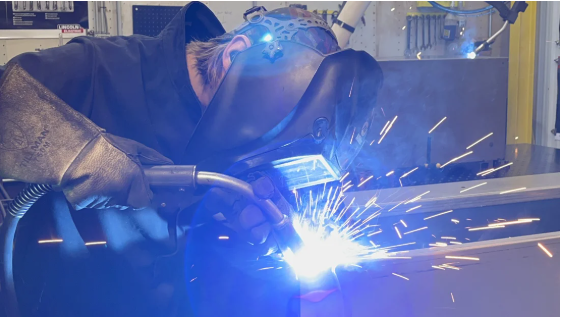
Not all joints are equally suited for MIG, TIG, stick, or robotic welding. Proper joint design, including fit-up, gap control, and edge prep, reduces rework and supports consistent throughput.
7. Clearly communicate weld intent
Use standard weld symbols and precise callouts. Ambiguous instructions lead to over-welding, under-welding, unnecessary inspections, and production delays.
Bottom line:
A weld-friendly design respects heat, access, sequence, and automation. If an assembly can be fixtured easily, welded cleanly, whether manually or through robotic welding services, and inspected without guesswork, you’re delivering true value-added metal fabrication from design through production.